
The Advice That Could Cost Your Business
By Halim Chew | Hache Business Consultancy (HacheBC)
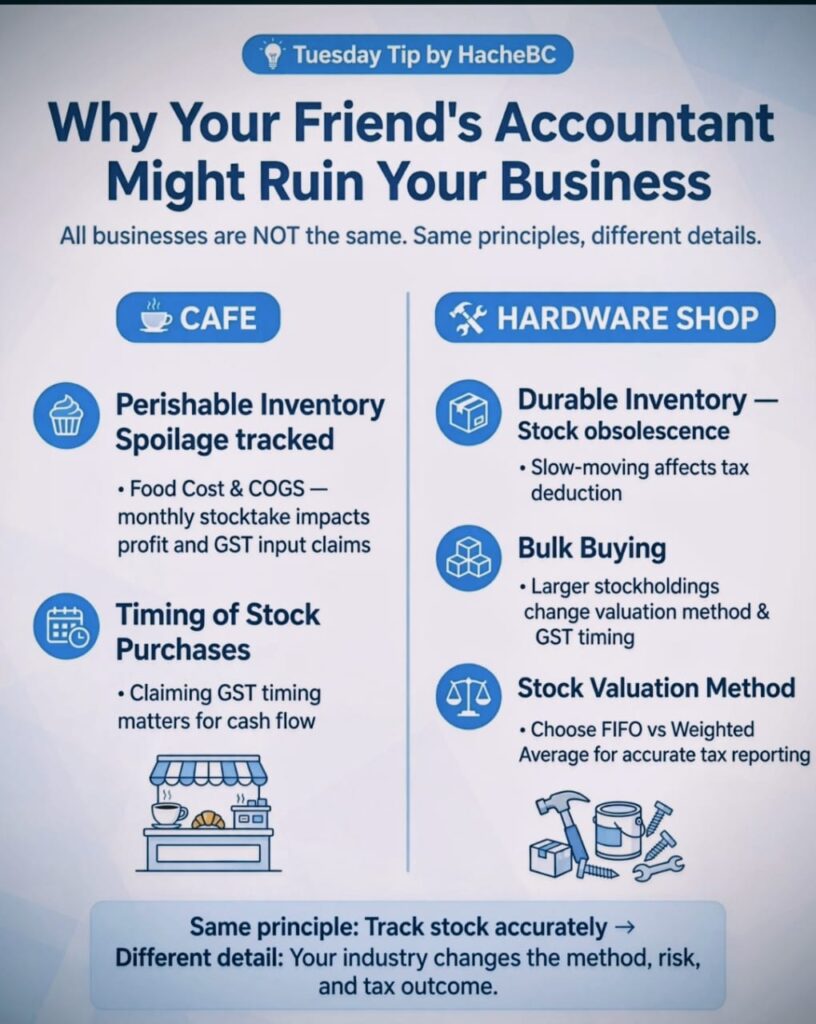
Have you ever heard someone say this?
“My friend’s café uses this accountant. The fees are cheap, and the service is good. Why don’t you use the same accountant?”
It sounds like sensible advice. After all, if someone you trust has found a good accountant, why not follow their recommendation?
There is nothing wrong with getting referrals. In fact, recommendations can be a useful starting point when looking for professional accounting services.
However, there is one important question every business owner should ask before making that decision:
Does that accountant understand the way YOUR business operates?
As an accountant by background and an entrepreneur by experience, I’ve learned that accounting is not simply about recording transactions, preparing financial statements and submitting tax returns.
It is also about understanding the business behind the numbers.
And that is where choosing the right accounting support becomes important.
1. All Businesses Are Not the Same
Accounting principles provide a common foundation for businesses. Revenue must be recorded properly, expenses must be classified correctly, and financial information must be reliable.
But applying those principles effectively requires an understanding of each business’s operations.
Let’s compare two businesses: a café and a hardware shop.
Example A: Running a Café
A café owner deals with operational challenges that can directly affect profitability.
These may include:
- Perishable inventory: Ingredients can expire, spoil or become unusable.
- Food wastage: Unsold food and preparation waste can quietly reduce profit margins.
- Staff scheduling: Different shifts, overtime and part-time workers affect labour costs.
- Daily sales patterns: Breakfast, lunch and dinner periods may produce very different sales results.
- Applicable tax obligations: The business must understand the taxes and reporting requirements relevant to its activities.
Imagine a café reporting RM50,000 in monthly sales. That figure might look encouraging, but how much food was wasted? How much did staffing cost during quiet periods? Were ingredient costs rising faster than selling prices?
Without tracking these details, the owner might see increasing sales while actual profitability deteriorates.
Example B: Running a Hardware Shop
A hardware shop faces a different set of challenges.
Its accounting and inventory processes may need to address:
- Large product ranges: Hundreds or thousands of stock-keeping units (SKUs) may require accurate tracking.
- Supplier credit terms: Purchasing stock on credit creates payment obligations that must be managed carefully.
- Bulk purchasing: Buying in larger quantities may reduce unit costs but tie up cash in inventory.
- Import-related costs: Where applicable, duties, freight and other landed costs affect inventory valuation.
- Slow-moving stock: Products can remain on shelves for months, tying up working capital.
A hardware shop could report strong sales but still experience cash flow problems because too much money is tied up in inventory or customers have not paid their invoices.
The café and hardware shop may use similar financial statements, but the operational questions behind those statements are very different.
The accounting format may be similar. The business reality is not.
2. What Happens When Your Accounting Does Not Reflect Your Business?
The problem is not necessarily that an accountant lacks competence. It may be that the accounting service or process does not sufficiently address the specific needs of the business.
When important operational details are overlooked, several problems can arise.
You May Not Know Your True Profit Margin
Revenue alone does not tell you whether a product, service or branch is profitable.
A café may need to understand food cost and wastage. A hardware shop may need to assess product margins, supplier pricing and slow-moving inventory.
If you cannot identify where your profit comes from, it becomes harder to decide what to promote, what to discontinue and where to control costs.
Cash Flow Problems May Go Unnoticed
Profit and cash flow are not the same thing.
Your business may record a profit but struggle to pay suppliers, salaries or rent because customers have not paid or too much cash is tied up in stock.
An effective accounting process should help business owners understand not only their financial results but also their cash commitments and collection patterns.
Tax and Reporting Errors May Occur
Every business must comply with the tax and reporting requirements applicable to its circumstances.
Poor records, incorrect classifications or misunderstood transactions can increase the risk of errors, missed obligations and unnecessary complications.
The answer is not to assume that one accountant is better than another. It is to ensure that your accounting process properly reflects your business activities and relevant compliance requirements.
3. Five Questions to Ask Before Choosing an Accountant
Before appointing an accountant or changing your current accounting service, ask these five questions.
1. Do you understand my industry?
Your accountant does not necessarily need to specialise exclusively in your industry. However, they should be willing and able to understand its important operational characteristics.
2. Can you help me understand my profit margins?
Ask how your financial reports can help you evaluate revenue, direct costs, overheads and profitability.
3. Will you help me identify cash flow risks?
Understand whether the service includes useful reporting on receivables, supplier payments, inventory commitments and upcoming cash requirements.
4. Can you explain the tax and reporting obligations relevant to my business?
You should understand what needs to be done, which records are required and when action is necessary.
5. Will you explain the numbers in language I understand?
Financial reports should not leave you wondering what the figures mean. You should be able to use them to make informed business decisions.
The right accounting support should help you understand your business better, not simply deliver reports that you struggle to interpret.
4. Accounting Should Be More Than Compliance
Preparing accounts and meeting tax deadlines are important. But for many SMEs, the value of accounting goes further.
Consider what could happen when you understand your numbers:
- You can identify expenses that are increasing too quickly.
- You can assess whether your selling prices cover your costs.
- You can spot slow-paying customers and plan collections.
- You can make better-informed purchasing and expansion decisions.
- You can prepare more effectively for tax obligations and regulatory changes.
These benefits depend on accurate records, relevant analysis and timely information. Accounting alone cannot guarantee business success, but better financial visibility gives owners a stronger foundation for decision-making.
For an SME operating with limited resources, that visibility can make a meaningful difference.
5. How HacheBC Approaches Your Business
At Hache Business Consultancy (HacheBC), we believe that understanding the business should come before making assumptions about its numbers.
Every business has its own structure, challenges and priorities. A restaurant, a trading company, a professional services firm and an online seller may all need accounting support, but they do not necessarily need the same level of attention in every area.
Our approach is to understand your business circumstances and identify the support that fits your needs.
Depending on your requirements, HacheBC can assist with:
- Accounting services: Organising financial records and helping you understand your business performance.
- Tax services and tax preparation: Supporting relevant tax compliance and preparation requirements.
- e-Invoicing support: Helping businesses understand and prepare for applicable e-Invoicing requirements.
- Business analysis: Examining financial and operational information to identify areas that need attention.
- Business development consultancy: Helping business owners assess opportunities, challenges and practical next steps.
The appropriate scope of work depends on your business and its circumstances. Our goal is to provide practical support that helps you make better-informed decisions.
6. Don’t Choose an Accountant on Price Alone
Professional fees matter, especially when you are running a small business with a tight budget.
However, the cheapest service is not necessarily the best value, and the most expensive service is not automatically the best either.
Look at what you receive for the fees you pay.
Does the service meet your compliance needs? Are your records handled accurately? Can you get useful answers to your questions? Do you understand what your financial reports are telling you?
Most importantly, does the service help you maintain a clearer picture of your business?
Choose an accountant based on competence, communication, relevant experience and the suitability of the service—not price or a friend’s recommendation alone.
A referral can open the door. Your own business needs should determine whether you walk through it.
Final Thoughts: Your Business Deserves Individual Attention
I believe that every business deserves to be understood on its own terms.
Accounting principles may be shared, but business owners face different operating costs, inventory challenges, cash flow pressures and compliance requirements.
As an accountant and entrepreneur, I understand why business owners want affordable, reliable professional support. I also believe that financial information becomes far more useful when it is connected to the reality of running a business.
At HacheBC, our philosophy is simple: understand the business, understand the numbers, and help the owner make better-informed decisions.
Because your business is unique. Your accounting should reflect that.
Let’s Talk About Your Business
Are you confident that your current accounting process reflects the real challenges of your business?
Whether you need accounting services, tax support, e-Invoicing guidance or a clearer understanding of your business performance, HacheBC is here to help you explore the options.
Visit HacheBC.com to learn more about our services or WhatsApp us here.
Hache Business Consultancy (HacheBC)
Minding Your Business Matters.