
Why Malaysian SME owners must stop doing everything themselves and start building businesses that can run without them.
Have you ever felt that your business cannot survive a single day without you?
You arrive early, leave late, answer calls during dinner, solve staff problems on your day off and worry about money even when you are supposed to be resting.
When a customer complains, you handle it.
When a staff member makes a mistake, you fix it.
When stock runs out, you rush to reorder it.
When the accounts do not balance, everyone looks at you.
And when you finally decide to take a short break, your phone refuses to give you one.
Sound familiar?
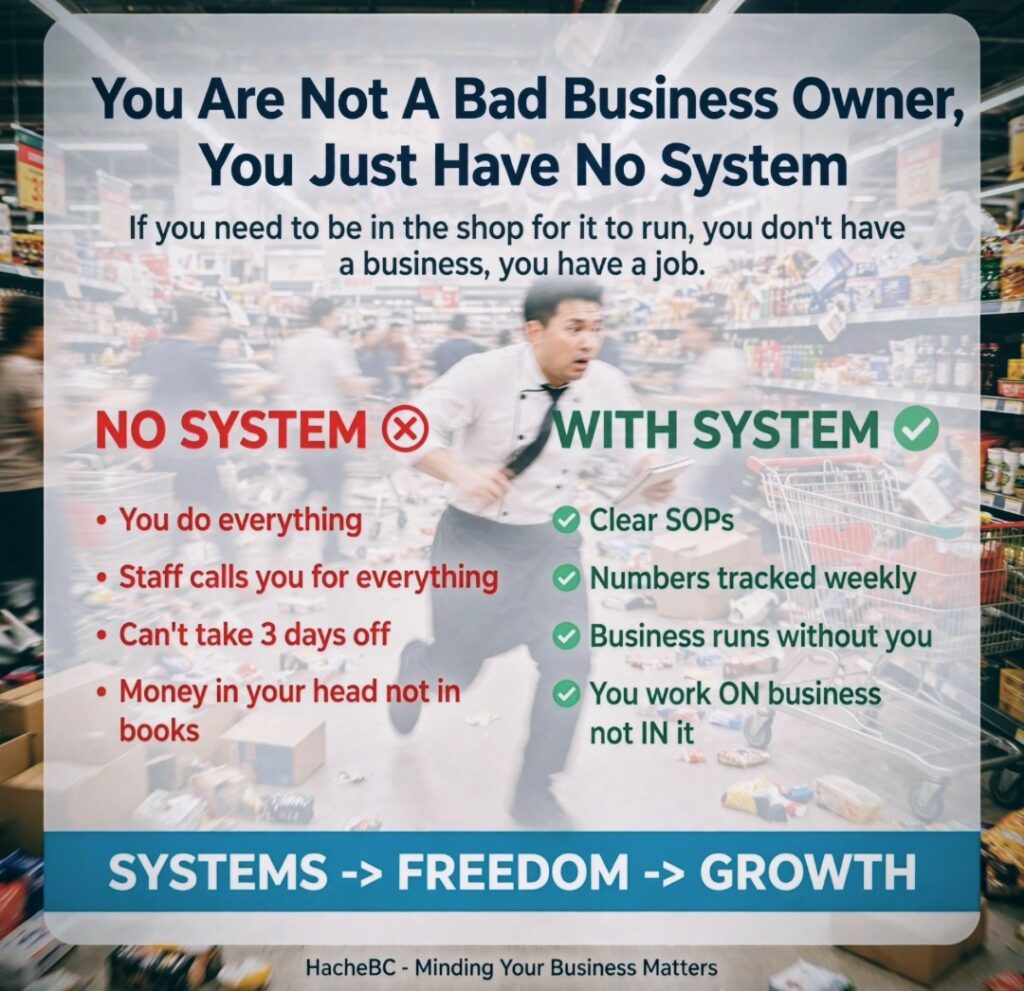
Imagine a chef wearing a necktie, running through a chaotic supermarket, trying to cook, manage stock, answer suppliers, supervise staff and keep customers happy—all at the same time.
It sounds ridiculous.
Yet many business owners live exactly like that every day.
They are not necessarily bad business owners. They may be hardworking, talented and deeply committed to their customers.
The real problem is often that the business depends too heavily on one person.
If your business cannot function without your constant involvement, you may have created a job for yourself rather than a business that can operate independently.
And the solution is not necessarily to work harder.
It is to build better systems.
1. When You Become the Business’s Biggest Bottleneck
Many entrepreneurs start their businesses by doing everything themselves.
At the beginning, this makes sense. Money is limited, the team is small, and the owner needs to understand every part of the operation.
You handle the sales, purchase the stock, speak to customers, supervise staff and manage the finances.
The problem begins when the business grows but the way it operates never changes.
You hire employees, but they still ask you what to do.
You acquire more customers, but every complaint comes back to you.
You increase sales, but you remain the only person who understands the stock situation or cash position.
Eventually, you become the person through whom every important decision must pass.
This creates a bottleneck.
Your employees cannot move forward without your approval. Small problems consume your time. Important decisions are delayed because you are busy solving routine issues.
And because you are constantly occupied, you have less time to think about expansion, profitability, marketing and the future of the business.
The irony is that your dedication, which helped the business get started, can eventually limit its growth.
A business should benefit from its owner’s involvement without becoming completely dependent on it.
2. Four Warning Signs Your Business Needs Better Systems
Warning Sign 1: Your Staff Need You for Everything
If employees call you every time a customer requests a refund, a supplier delivers the wrong quantity or a product runs out of stock, ask yourself why.
Is the situation genuinely too complex for them to handle?
Or have you never established clear procedures and decision-making limits?
Staff cannot be expected to make consistent decisions when the rules exist only in the owner’s head.
A simple system should explain what employees can decide independently, what steps they must follow and when they need to escalate a problem.
For example, a café manager might be authorised to resolve a minor customer complaint within an agreed limit without contacting the owner.
The owner can then focus on issues that genuinely require their attention.
Warning Sign 2: You Cannot Take Three Days Off
Imagine taking three days away from your business.
No routine phone calls. No constant messages. No emergency trips back to the shop.
Would the business continue operating properly?
If the answer is no, do not immediately blame your employees.
Look at the structure of the business.
Are opening and closing procedures documented? Can staff reorder essential stock? Is there someone responsible for daily operations? Can another authorised person access the information needed to make decisions?
A business does not become independent simply because the owner takes a holiday.
It becomes more resilient when responsibilities, procedures and authority are clearly established before the owner leaves.
Of course, some businesses will always need owner involvement in major decisions. The objective is not to eliminate the owner. It is to reduce unnecessary dependence on the owner.
Warning Sign 3: Your Financial Information Exists Only in Your Head
You know roughly how much money is in the bank.
You remember which suppliers need to be paid.
You have a feeling that sales were good last week.
But can you answer these questions confidently?
- What was your actual profit last month?
- Which products or services generated the strongest margins?
- How much money do customers still owe you?
- What payments are due over the next two weeks?
- How much stock is sitting unsold?
If the answers require you to search through messages, receipts and scattered spreadsheets, your business may lack a reliable financial reporting routine.
Financial information should not depend on your memory.
Your records need to be maintained, your figures reviewed and your cash commitments monitored regularly.
When your numbers are organised, you can identify problems earlier and make decisions based on evidence rather than instinct alone.
Warning Sign 4: You Are Always Busy but the Business Is Not Improving
You spend twelve hours a day at work.
You answer hundreds of messages, solve endless problems and supervise every detail.
Yet the business seems to be standing still.
Sales are inconsistent. Expenses keep increasing. Staff remain dependent on you. You have no time to develop new opportunities.
This is what happens when operational activity consumes all your attention.
You may be working extremely hard in the business without having enough time to work on the business.
Working in the business means serving customers, preparing orders, checking stock and handling daily operations.
Working on the business means improving the way those activities are performed, analysing performance, developing staff and deciding where the business should go next.
Both are necessary, especially in a small company. But if daily operations consume every available hour, long-term improvement becomes difficult.
3. What Does a Business System Actually Look Like?
The word “system” can sound complicated.
You might imagine expensive software, consultants, thick procedure manuals or a large management team.
But a small business does not need to begin there.
A useful system is simply a repeatable way of doing something that produces a reasonably consistent result.
Start with three foundations.
System A: Clear Standard Operating Procedures (SOPs)
An SOP documents how a routine task should be completed.
For example, a retail shop could establish simple procedures for:
- Opening and closing the premises.
- Receiving and checking deliveries.
- Recording stock movements.
- Handling customer complaints.
- Processing sales and refunds.
- Preparing daily cash and sales reports.
The purpose is not to create paperwork for its own sake.
It is to make the expected process clear enough that trained employees can perform routine tasks without needing the owner to explain everything repeatedly.
Start with the tasks that cause the most confusion, errors or interruptions. Document those first, test the procedures in practice and update them when necessary.
System B: A Weekly Numbers Review
A business needs a regular financial check-up.
Depending on the nature of the business, a weekly review might include:
- Sales compared with the target.
- Major expenses and unusual spending.
- Cash available and payments coming due.
- Outstanding customer invoices.
- Stock shortages or slow-moving inventory.
- Operational issues affecting profitability.
A weekly review does not replace proper monthly accounts, financial statements or tax compliance. It provides an earlier view of what is happening so the owner can respond before a small issue becomes a larger one.
For example, a shop may appear busy while its cash position deteriorates because too much money is tied up in stock.
Without regular monitoring, the owner may only discover the problem when supplier payments become difficult.
System C: Defined Responsibilities and Decision-Making Authority
Every recurring responsibility should have a clear owner.
Who checks inventory? Who approves purchases? Who follows up on overdue invoices? Who prepares the daily sales report? Who handles customer complaints?
For each task, establish:
- Who is responsible.
- What must be done.
- When it must be completed.
- What standard must be met.
- When the matter should be escalated.
This creates accountability without requiring the business owner to supervise every action personally.
Importantly, delegation should come with suitable training, access to information and appropriate controls. Giving employees responsibility without the authority or tools to fulfil it will only create another problem.
4. Systems Create Freedom—but Only When the Numbers Work
There is an important point that business owners sometimes overlook.
A business can have well-written procedures and still lose money.
Employees may follow every instruction correctly while product margins remain too low. Sales may increase while cash flow deteriorates. Stock may be organised perfectly but move too slowly to justify the capital invested in it.
Operational systems and financial controls must work together.
Consider a simple example.
A café owner introduces a stock-reordering procedure. Previously, employees ordered ingredients whenever they thought supplies were running low. This resulted in occasional shortages and unnecessary purchases.
The new procedure establishes minimum stock levels, records usage and requires approval for larger orders.
Now the owner can monitor stock more consistently, reduce avoidable wastage and understand purchasing patterns.
But there is another benefit: the owner can examine whether food costs are appropriate relative to sales.
The system does more than make daily operations smoother. It creates information that supports better financial decisions.
This is why business systems should not be treated as isolated administrative exercises.
The goal is to build a business that operates consistently, protects its cash flow and produces useful information for decision-making.
5. How to Start Building Your Systems Without Spending a Fortune
If your business currently depends on you for everything, do not try to fix the entire operation in one week.
Start small.
Step 1: Identify Your Biggest Daily Interruption
For one week, record the questions and problems that repeatedly pull you away from important work.
Are employees asking about discounts? Are suppliers calling because payments are unclear? Are customers waiting for approvals? Are stock shortages happening repeatedly?
Look for patterns.
The same problem occurring every day is often a sign that a process needs to be clarified.
Step 2: Choose One Process to Improve
Select the issue that causes the greatest disruption or financial risk.
Write down the steps required to handle it properly.
Keep the instructions practical. A one-page checklist that staff actually use is more valuable than a twenty-page manual nobody reads.
Step 3: Assign Responsibility
Choose the appropriate person to manage the process.
Explain the expected outcome, provide training and clarify which decisions they can make independently.
Do not simply hand over a task and assume the employee will figure everything out.
Step 4: Measure the Result
Determine whether the new procedure is working.
For example, track how often staff need to call you about the same issue, how many stock discrepancies occur or how quickly daily sales reports are completed.
Use the results to improve the process.
Step 5: Repeat
Once the first system works reasonably well, move to the next recurring problem.
Over time, these improvements can reduce unnecessary interruptions and help the business operate more consistently.
You do not need to transform everything overnight.
You need to make the business a little less dependent on you, one process at a time.
6. The Real Role of a Business Owner
Being a business owner does not mean you should never perform operational work.
In a small business, especially during its early stages, owners often need to remain closely involved.
The problem is not working in the business. The problem is having no opportunity to improve it because you are permanently trapped in daily operations.
As the business develops, your role should gradually evolve.
Instead of personally solving every stock issue, you establish a stock-control process.
Instead of answering the same staff questions repeatedly, you document the correct procedure and train your team.
Instead of guessing whether the business is profitable, you review reliable financial information.
Instead of being the only person who knows what is happening, you build a structure in which the right people can access the right information and make appropriate decisions.
This does not make you less important.
It allows you to contribute at a higher level.
A well-managed business still needs leadership, judgement and accountability. But those qualities should strengthen the system rather than substitute for one.
Final Thoughts: Stop Being the Entire System
If you recognise yourself in the image of the exhausted chef running through a chaotic supermarket, take a moment before blaming yourself.
You may not be lazy. You may not lack entrepreneurial ability. You may simply have reached the point where the informal methods that worked when your business was small are no longer sufficient.
The next stage of growth requires a different approach.
Document what matters. Give people clear responsibilities. Review your numbers regularly. Monitor your cash flow. Build procedures that help the business operate consistently even when you are not personally handling every task.
And remember that building systems is a process. It takes time, training, review and adjustments.
Your goal is not to make yourself unnecessary.
It is to stop making yourself the solution to every problem.
Systems create consistency. Consistency creates room to improve. And improvement gives your business a better chance to grow without consuming your entire life.
Need Help Finding the Gaps in Your Business?
At Hache Business Consultancy (HacheBC), we believe better business decisions start with understanding how your business actually operates.
From financial visibility and cash flow to business analysis and development, the first step is identifying where the problems are—and which improvements matter most.
If your business depends on you for every decision, it may be time to examine the systems behind the daily activity.
Visit HacheBC.com to learn more about our services, or chat with HacheBC on WhatsApp to discuss your business challenges.
HacheBC — Minding Your Business Matters.