
The story of a family business, an ageing father, and a son who inherited a business he didn’t know how to run.
Uncle Tan had spent 30 years building his wholesale business.
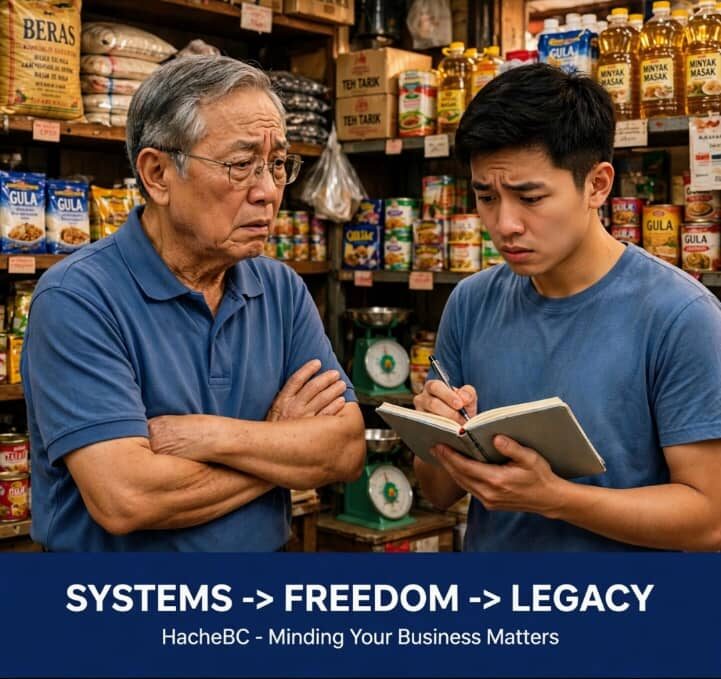
He had sacrificed weekends, missed family dinners, and worked through countless difficult days. Every morning at 6 am, he opened the shop. Many nights, he was the last person to leave.
He knew his suppliers by name. He remembered prices without checking a spreadsheet. He recognised customers by their faces and knew which ones paid on time, which ones needed reminders, and which ones could be trusted with credit.
The business was his life.
After three decades of hard work, Uncle Tan finally began thinking about retirement.
He had a son who could take over. The business had customers, suppliers, employees, and a reputation built over many years. Surely, handing it to the next generation was the natural next step.
But when his son came in to learn the business, a difficult truth emerged.
His father had built a business that depended on him knowing everything. He had not built a business that someone else could easily run.
Thirty years of experience, but where was the system?
Uncle Tan’s son was willing to learn. He asked questions, took notes, and tried to understand how everything worked.
But every answer led to another question.
How were selling prices determined? Which suppliers offered the best credit terms? How much stock should be ordered? Which customers had outstanding balances? How much profit did the business really make each month?
Some answers were in notebooks. Others were in old invoices, spreadsheets, or the memories of long-serving employees.
Many existed only in Uncle Tan’s head.
There were four major problems.
1. No standard operating procedures
Staff knew how to perform their daily tasks, but many had learned through observation and verbal instructions.
When something unusual happened, they went to Uncle Tan.
His son could not easily distinguish between a formal business rule and a habit his father had developed over the years.
Without documented procedures, every decision became a question — and every question sent him back to his father.
2. No clear picture of the business’s financial health
Uncle Tan knew whether business was good or bad based on sales, bank balances, supplier payments, and years of experience.
But those indicators did not necessarily reveal the whole picture.
How much profit did each product generate? How much money was tied up in stock? Which customers were slow to pay? Could the business afford to expand or increase staff costs?
Without reliable, up-to-date accounts and meaningful financial reports, his son had to make decisions without the same understanding his father had developed over 30 years.
Sales are not profit. Cash in the bank is not necessarily money available to spend.
A successor needs more than access to the bank account. He needs to understand the financial engine behind the business.
3. Supplier and customer relationships existed mainly in his father’s memory
Uncle Tan knew who to call when stock was unavailable, which supplier could deliver urgently, and which customer needed a little extra attention.
But were supplier contacts, agreed prices, credit limits, payment terms, and customer histories documented in one accessible place?
Not consistently.
Relationships built over decades are valuable business assets. However, when important information is not recorded, the business risks losing continuity when its key person steps away.
Personal relationships still matter. A good system helps preserve them rather than replace them.
4. No clear process for transferring responsibility
Uncle Tan had always made the important decisions.
His son had not been given a structured transition plan, clear decision-making authority, or a defined period to learn the business in stages.
There was no practical roadmap showing what the son should learn first, which responsibilities he could assume next, and how the father would eventually step back.
The result? His son could be present every day and still not be ready to take over.
The problem wasn’t the father. It wasn’t the son.
It would be easy to blame Uncle Tan for failing to document his business.
It would also be unfair to blame his son for not learning 30 years of experience in a few weeks.
The real problem was that the business had grown around one person instead of developing systems that allowed knowledge to be shared.
This happens in many small and family-owned businesses. The founder is the salesperson, purchasing manager, financial controller, operations supervisor, and final decision-maker — sometimes all before lunchtime.
That approach may work for years. It can even help a business survive its early stages.
But as the business grows, the founder’s knowledge becomes a bottleneck.
And when retirement, illness, an emergency, or a change in family circumstances arrives, the business may struggle to operate without the founder.
A business that cannot function without its owner may be valuable, but its dependence on that owner can limit its transferability, resilience, and potential value to a successor.
How can you build a business that can outlive you?
You do not need an expensive enterprise system or a large consulting budget to begin.
You need to start documenting what matters and improve the process step by step.
Step 1: Write down how the business operates
Start with the activities that happen every day.
Document how you open and close the business, process orders, purchase stock, receive payments, handle complaints, approve discounts, and pay suppliers.
Keep each procedure simple. State who is responsible, what steps they follow, which records they maintain, and when they should escalate a problem.
Do not try to document every possible situation at once. Begin with the five processes that would cause the greatest disruption if you were absent.
Step 2: Know your numbers
A successor needs to understand more than the total sales figure.
At a minimum, work towards having reliable records and regular reports covering:
- Sales and gross profit.
- Operating expenses and net profit.
- Cash flow and upcoming payments.
- Stock levels and slow-moving inventory.
- Customer debts and overdue receivables.
- Supplier balances and payment terms.
The exact reports will depend on the type and size of your business.
The goal is simple: your successor should be able to understand the business’s financial condition without having to guess what you remember.
Step 3: Create a supplier and customer directory
Record contact details, product or service information, agreed prices where relevant, payment terms, credit limits, delivery arrangements, and outstanding issues.
Restrict access to sensitive commercial information appropriately.
This is not about reducing relationships to a spreadsheet. It is about ensuring that the next generation can maintain those relationships with knowledge and confidence.
Step 4: Delegate decisions gradually
Documentation alone does not create a capable successor.
Give your chosen successor responsibility in stages. Let them handle routine purchasing, review weekly financial reports, speak with suppliers, and manage operational problems within agreed limits.
Review the results together.
Over time, move from answering every question to reviewing decisions, discussing exceptions, and sharing the reasoning behind important choices.
The objective is not to make the next generation run the business exactly as you did. It is to give them the information, authority, and judgment needed to run it responsibly.
Step 5: Plan the handover before you need it
A proper succession plan involves more than handing over keys and introducing a new boss.
Consider who will own the business, who will manage it, how responsibilities will transfer, and what happens if the founder becomes unavailable earlier than expected.
Depending on the business structure and family circumstances, professional advice on legal, tax, ownership, and estate-planning matters may also be necessary.
Start these discussions early. A gradual transition gives everyone more time to learn, ask questions, and resolve disagreements.
Your business should support your life, not hold it hostage
Think about what you wanted when you first started your business.
Perhaps you wanted financial independence, a better future for your family, or something you could eventually pass on to your children.
After years of hard work, you deserve to have choices.
You should be able to take a holiday without answering every operational question. You should be able to spend time with your family without worrying that a routine decision will bring the business to a standstill.
And if your children want to continue what you have built, they should inherit an opportunity — not an impossible task of reconstructing everything that exists only in your memory.
Of course, not every business needs to be passed to the next generation. Some owners may choose to sell, appoint professional management, or close their business when the time comes.
Whatever your preferred outcome, reliable systems and financial records give you more options.
You did not spend 30 years building your business just to become trapped in it.
Build it so that it can function without your constant presence. Build it so that the next generation can understand it. Build it so that the value of your hard work has a chance to continue.
SYSTEMS → FREEDOM → LEGACY
At HacheBC, we believe that understanding a business goes beyond preparing accounts or looking at its sales figures.
It means understanding how the business operates, where its money comes from, where it goes, what risks it faces, and whether its systems can support its future.
Every business is different. A wholesale distributor does not operate like a café, and a family-owned retailer does not face exactly the same challenges as a professional services firm.
That is why the starting point should be understanding your business before deciding what needs to change.
If your business still depends heavily on everything you remember, you do not have to fix everything overnight.
Start with one process. One financial report. One supplier list.
Then build from there.
Need help identifying where to start?
HacheBC can help you review your business records, financial visibility, and operating processes, then identify practical next steps based on your circumstances and the scope of support agreed.
Chat with HacheBC on WhatsApp
HacheBC — Minding Your Business Matters.