
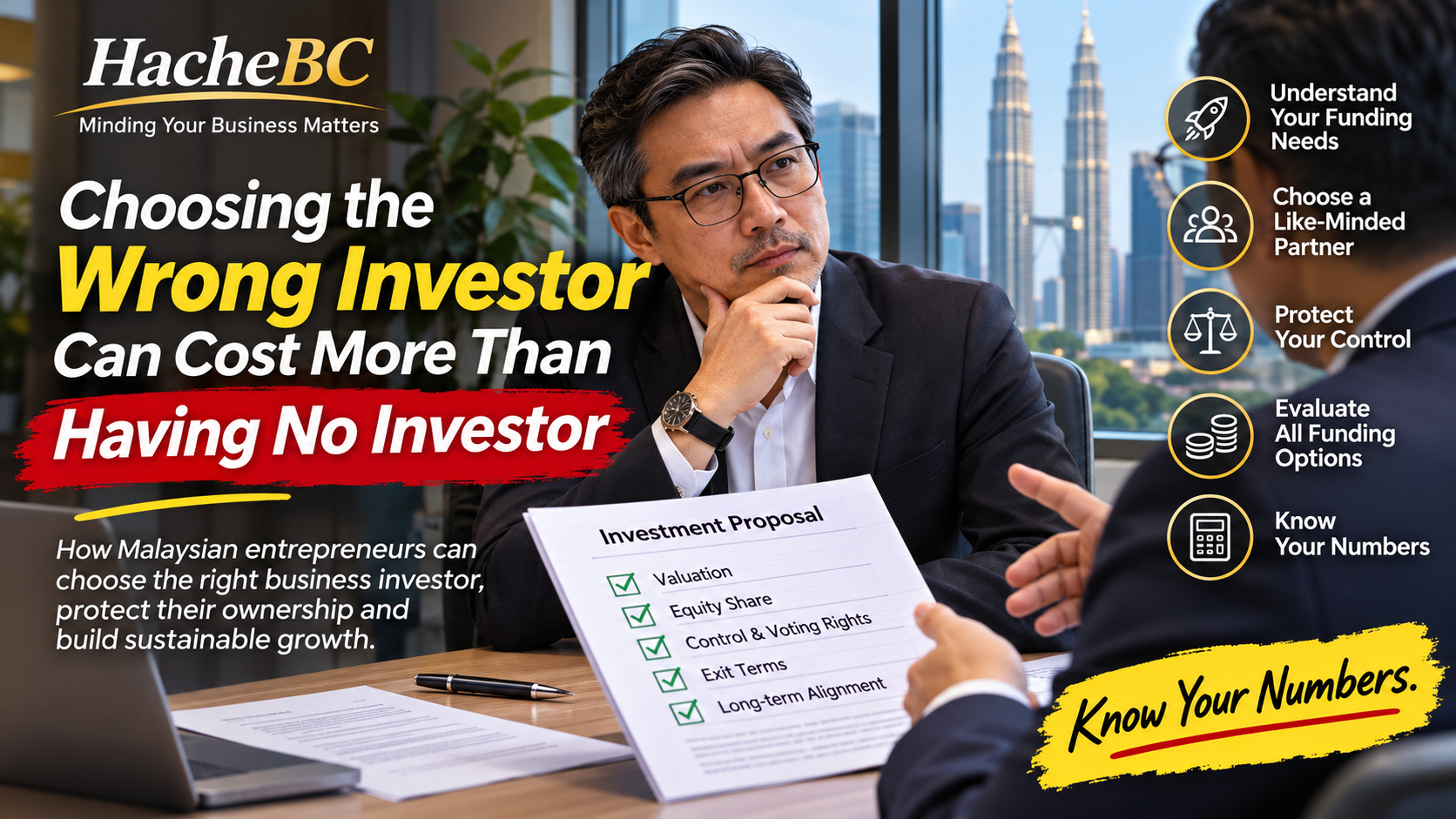
How Malaysian entrepreneurs can choose the right business investor, protect their ownership and build sustainable growth.
How Malaysian entrepreneurs can choose the right business investor, protect their ownership and build sustainable growth.
By Halim Chew | HacheBC — Minding Your Business Matters
Every entrepreneur dreams of taking their business to the next level.
Some want to open more branches. Others want to develop new products, enter international markets or build technology that could transform an entire industry.
Eventually, many business owners face the same question:
Should I bring an investor into my business?
The answer may seem straightforward. An investor provides capital, and capital helps a business grow.
But there is something entrepreneurs often overlook.
Choosing an investor is a little like choosing a marriage partner. The right person can help you build a future. The wrong person can make that future extremely difficult.
Money matters. But the person behind the money matters just as much.
Why Malaysian SMEs Look for Business Investors
Many small and medium enterprises (SMEs) in Malaysia face challenges when financing business expansion.
A business may have a promising product, loyal customers and strong growth potential but lack sufficient working capital to expand.
Consider a small food manufacturer that wants to increase production capacity.
The business may need additional machinery, larger premises, packaging equipment, inventory and staff before it can fulfil bigger orders.
Or consider a technology startup developing software for Malaysian businesses.
The founders may need funding for software engineering, cybersecurity, testing, marketing and customer support before the platform can generate sustainable revenue.
In both situations, outside investment may accelerate growth.
However, raising capital and building a financially sustainable business are two different things.
An investor can provide money, but money alone cannot guarantee commercial success.
The Hidden Cost of Choosing the Wrong Investor
Imagine you have spent years developing your business.
You understand the customers, the market and the opportunities ahead.
An investor offers RM500,000 in exchange for a substantial shareholding.
You accept because the business desperately needs funding.
At first, everything seems promising.
Then disagreements begin.
The investor wants rapid expansion, while you prefer controlled growth.
You want to reinvest profits, but the investor expects early distributions.
You want to strengthen operations, but the investor demands aggressive sales targets.
Eventually, you discover that you and your investor have fundamentally different expectations.
The business now has more capital but less harmony.
Worse, you may have agreed to shareholder rights that limit your ability to make important decisions.
The real cost of a poor investment arrangement is not merely the percentage of shares you surrender. It may include lost independence, management conflict, delayed decisions and damaged business relationships.
That is why choosing the right business investor in Malaysia requires much more than comparing investment offers.
1. Understand Why Your Business Needs Capital
Before approaching investors, ask yourself:
What exactly will the investment money achieve?
Do you need capital to purchase machinery, develop technology, hire employees, finance inventory or enter a new market?
These objectives require different funding strategies.
For example, a business seeking RM300,000 should be able to explain how the funds will be used and what milestones the investment is expected to support.
A simple funding plan might look like this:
| Proposed use | Amount |
|---|---|
| Product development | RM120,000 |
| Staff and technical expertise | RM90,000 |
| Marketing and customer acquisition | RM45,000 |
| Testing and compliance | RM25,000 |
| Contingency | RM20,000 |
| Total | RM300,000 |
Illustrative figures only.
Without a clear funding plan, even a substantial investment can disappear quickly.
At HacheBC, we believe every major business decision should begin with understanding the numbers.
Know Your Numbers before asking someone else to invest in them.
2. Understand How Investment Affects Business Ownership
For Malaysian entrepreneurs operating through a Sdn Bhd, bringing in an equity investor may involve issuing or transferring company shares.
This changes the ownership structure of the business.
Consider a simplified example.
You initially own 100% of your company.
An investor agrees to invest RM250,000 at an agreed pre-money company valuation of RM750,000.
The post-money valuation becomes RM1 million.
If the investment is made through newly issued ordinary shares on those terms, the investor would generally own 25% and your ownership would be diluted to 75%.
But the percentage alone does not tell the whole story.
You must also understand:
- Voting rights and board representation
- Shareholder approval requirements
- Dividend policies
- Restrictions on transferring shares
- Rights relating to future fundraising
- Exit arrangements and dispute resolution
- Any special rights granted to particular shareholders
A founder can retain a majority shareholding yet still face significant contractual restrictions.
Before signing any investment agreement, obtain appropriate legal and corporate advice.
3. Choose an Investor Who Understands Your Business
Not every investor is suitable for every business.
An investor experienced in property development may not necessarily understand the challenges of developing enterprise software.
Similarly, someone familiar with retail operations may have different expectations from an investor who specialises in manufacturing.
Industry knowledge can be valuable.
A suitable investor may contribute more than money through customer introductions, distribution networks, management experience, technical knowledge or strategic guidance.
But these benefits should be evaluated realistically.
Ask potential investors about their experience with businesses at your stage of development.
Ask how they approach setbacks.
Most importantly, ask what they expect from you.
4. Discuss Expectations Before Discussing the Cheque
One of the biggest mistakes entrepreneurs make is focusing on how much an investor will contribute without fully discussing what the investor expects in return.
Important questions include:
How long is the investment horizon?
Does the investor expect returns within three years, five years or longer?
What happens if the business grows more slowly than expected?
Will the investor support a revised strategy, or pressure management into taking unnecessary risks?
Who makes major business decisions?
Will the founder continue managing daily operations independently?
What happens when the business needs more capital?
Will existing shareholders contribute additional funding? What happens if they decline?
How can either party exit the investment?
These discussions may feel uncomfortable.
But they are much easier before an investment agreement is signed than after disagreements arise.
5. Evaluate the Investor’s Character and Business Philosophy
Financial capability is important, but character should never be ignored.
Look for investors who communicate clearly, honour commitments, respect professional advice and understand that businesses experience both good and difficult periods.
Be cautious if a potential investor pressures you to sign immediately, refuses reasonable due diligence or makes promises that are not reflected in written agreements.
An investor who insists on unreasonable control before contributing capital may become even more difficult after joining the company.
Remember:
A good investor should strengthen the business, not undermine the people responsible for building it.
6. Consider Alternatives Before Giving Away Equity
Equity investment is not the only possible source of business funding.
Depending on eligibility and circumstances, Malaysian entrepreneurs may explore government-backed grants, accelerator programmes, strategic partnerships, customer-funded development or reinvestment of business profits.
For technology startups, programmes offered by organisations such as Cradle Fund may be worth investigating.
However, funding programmes have specific eligibility requirements, conditions, milestones and reporting obligations. Some may involve repayment or conversion provisions under certain circumstances.
Always review the current programme terms before applying.
The key is to compare funding alternatives based on their total financial and strategic cost, not simply the amount of money available.
7. Protect Your Cash Flow Even After Securing Investment
One dangerous misconception is that securing investment automatically solves a company’s financial problems.
It does not.
A company can raise RM1 million and still run out of cash if expenditure grows faster than revenue or if its financial controls are weak.
Investment capital must be supported by realistic cash-flow projections.
Business owners should monitor:
- Monthly operating expenses
- Cash burn rate
- Available cash runway
- Revenue and gross profit
- Customer acquisition costs
- Outstanding receivables and payables
- Budget variances
- Actual progress against funding milestones
For example, if a startup has RM300,000 available and spends RM25,000 per month without receiving additional cash, its simplified runway is approximately 12 months.
But that calculation assumes spending remains constant and ignores other cash movements.
The business must understand when additional funding may be required and whether its planned milestones can be achieved before the money runs out.
Capital provides opportunity. Financial discipline determines how effectively that opportunity is used.
8. Conduct Due Diligence on Your Investor Too
Investors normally investigate businesses before investing.
They examine financial records, market opportunities, management capability and commercial risks.
Entrepreneurs should also conduct reasonable due diligence on prospective investors.
Where appropriate, seek information about their professional background, business reputation, previous investments and ability to meet their funding commitments.
Speak to founders who have worked with them, where possible.
Clarify whether funding will come from the individual, a company or an investment vehicle.
Ensure investment commitments and conditions are properly documented.
Due diligence is not a sign of distrust.
It is responsible business management.
9. Don’t Rush Into an Investment Because You Need Money
Financial pressure can lead entrepreneurs into poor decisions.
When a business urgently needs capital, almost any investment offer can appear attractive.
But urgency can weaken negotiating power.
Where possible, begin preparing for fundraising before the company reaches a financial crisis.
Build reliable financial records, validate customer demand, develop realistic forecasts and document the business model.
A business with credible numbers and clear milestones is generally better positioned to negotiate than one seeking emergency funding.
Sometimes, slowing down the fundraising process is the wiser decision.
The objective is not to find the fastest investor. It is to find the right investor on terms the business can sustain.
10. Know Your Numbers Before Negotiating Your Company’s Future
Before accepting investment, every entrepreneur should understand the company’s current financial position.
At a minimum, prepare:
- Recent financial statements
- Cash-flow projections
- Existing liabilities and commitments
- Shareholding structure
- Business valuation assumptions
- Funding requirements
- Expected use of proceeds
- Commercial milestones
- Major business risks
Investors may challenge your assumptions.
That is normal.
What matters is your ability to explain how the business works financially and why your proposed growth strategy is reasonable.
A business owner who understands the numbers can make better decisions about valuation, dilution, funding requirements and financial sustainability.
Frequently Asked Questions
How do I find investors for my business in Malaysia?
Potential routes include professional networks, angel investors, strategic industry partners, startup accelerators and relevant investment programmes. Before approaching them, prepare a credible business plan, financial projections and a clear explanation of how the investment will be used.
How much equity should I give an investor?
There is no universal percentage. The appropriate equity allocation depends on the company’s valuation, funding requirements, investment terms, existing ownership and future capital needs. Founders should assess dilution and shareholder rights before agreeing to a transaction.
Can I retain control of my Sdn Bhd after accepting investors?
Potentially, yes. However, control depends on more than shareholding percentages. Voting arrangements, board composition, reserved matters and contractual rights can significantly influence decision-making.
Is a government grant better than an equity investor?
Not necessarily. Grants may reduce immediate equity dilution, but they can impose eligibility conditions, spending restrictions, reporting requirements and other obligations. Equity investors may provide valuable expertise and commercial networks. Each option should be evaluated on its own terms.
What should I prepare before meeting potential investors?
Prepare financial statements, realistic cash-flow forecasts, a business plan, funding requirements, ownership information and measurable growth milestones. Be ready to explain your business risks and how you intend to manage them.
Final Thoughts: Choose Your Business Partner as Carefully as Your Life Partner
Building a business requires commitment, sacrifice and resilience.
The same can be said about a successful long-term partnership.
An investor who shares your vision, understands your challenges and respects your responsibilities can become a valuable contributor to your company’s future.
The wrong investor can turn an exciting business opportunity into years of unnecessary conflict.
So before accepting that attractive investment offer, ask yourself:
Am I choosing this investor because we can build something valuable together, or simply because I need the money?
The answer could shape your company’s future.
At HacheBC, we believe sustainable business growth begins with informed decisions, sound financial management and a clear understanding of the numbers.
HacheBC — Minding Your Business Matters.
Know Your Numbers. Build Your Business Wisely.
For business accounting, financial analysis and business development enquiries, visit HacheBC.com or contact +60. 11-395.1 1377.
Disclaimer: This article provides general business information and does not constitute legal, investment or personalised financial advice. Investment arrangements should be reviewed with appropriately qualified professionals.